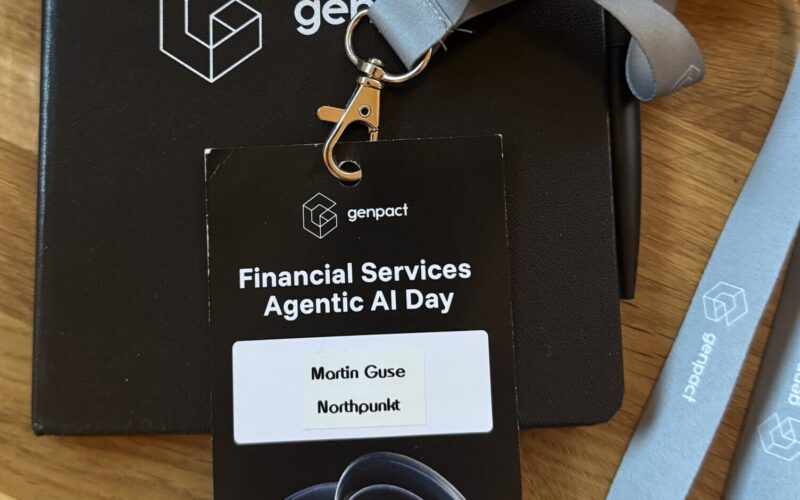
Um 4 Uhr morgens in Hamburg. Flug ab HAM um 6:25 Uhr. In München gelandet – mit genug Zeit, um eine Stunde zu spät anzukommen.
Die Deutsche Bahn hatte andere Pläne. Zugausfälle, eine kleine Navigationsübung durch Münchens Nahverkehr und der stille Optimismus, den nur eine Abflugtafel erzeugen kann. Classic.
Die gute Nachricht: Das Genpact-Team ließ mich trotzdem rein – und was ich dort erlebt habe, war den frühen Wecker wert.
KI als Infrastruktur – nicht als Experiment.
Genpacts Agentic AI Day war keine Produktschau. Es war eine Arbeitssession darüber, was KI heute bereits konkret in Financial Services leistet – von Financial Crime Detection über Auto Finance bis zu Procurement und Risk Management. Die Frage, die durch jeden Vortrag lief, war dieselbe: Wo sitzen autonome Agenten heute schon in Live-Prozessen? Nicht als Pilot. Nicht als Experiment. Als Infrastruktur.
Was mich beschäftigt hat, war eine Demonstration im Procurement-Bereich. Ein KI-Agent analysiert Lieferantendaten, bewertet Alternativen, erstellt eine Verhandlungsstrategie und formuliert konkrete Gesprächsempfehlungen – was fordern, wo nachgeben, welche Argumente ziehen.
Soweit, so beeindruckend.
Was passiert, wenn der Lieferant auf der anderen Seite dasselbe tut?
Wenn beide Seiten einen KI-Agenten einsetzen, der die Verhandlungsstrategie vorgibt – wer verhandelt dann eigentlich noch? Zwei KI-Systeme, die jeweils die optimale Position für ihre Seite berechnen, werden irgendwann feststellen, dass der Mensch in der Mitte vor allem eines tut: die Empfehlung umsetzen, die das System bereits ausgegeben hat.
Der logische nächste Schritt ist nicht schwer zu denken: Die Systeme handeln direkt miteinander aus. Ohne Meetingraum, ohne Reise, ohne Lebkuchenherz.
Das klingt nach Zukunftsmusik. Aber die Effizienzgewinne, die heute demonstriert werden, sind real. Und sie verändern eine Grundannahme, auf der viele Geschäftsmodelle im Financial Services beruhen: dass Informationsasymmetrie und Verhandlungsgeschick auf der einen Seite einen messbaren Vorteil erzeugen.
Wenn KI diesen Vorteil systematisch nivelliert – bei Kreditkonditionen, Leasingverträgen, Lieferantenverhandlungen – dann ist die relevante Frage nicht mehr „Wie optimiere ich meine Verhandlungsposition?“ Sondern: „Wo liegt mein Wert, wenn die KI das besser kann als ich?“
Human in the Loop bleibt – vorerst. Aber die Frage, an welcher Stelle und warum, wird dringlicher.
Das war den 4-Uhr-Wecker wert. Und den Umweg.
Up at 4am in Hamburg. Flight out of HAM at 6.25am. Landed in Munich with time to spare. And still managed to arrive an hour late.
Deutsche Bahn had other plans. Announced cancellations, a small navigational adventure through Munich’s public transit system and the kind of optimism only a departure board can provide. Classic.
The good news: the Genpact team was gracious enough to let me catch up — and what I walked into was worth every cancelled connection.
AI as infrastructure – not as an experiment.
Genpact’s Agentic AI Day wasn’t a showcase. It was a working session on what AI actually means for financial services operating models right now. From financial crime detection to auto finance, from procurement to risk management — the question running through every session was the same: where do autonomous agents sit inside live operations, today? Not as a pilot. Not as an experiment. As infrastructure.
What stayed with me was a demonstration in the procurement space. An AI agent analyses supplier data, evaluates alternatives, builds a negotiation strategy and formulates concrete recommendations — what to push for, where to give ground, which arguments land.
Impressive, to say the least.
What happens when the supplier on the other side does the same?
If both sides deploy an AI agent to define their negotiation strategy — who is actually negotiating? Two AI systems, each calculating the optimal position for their side, will eventually find that the human in the middle is doing one thing above all: executing the recommendation the system already produced.
The logical next step isn’t hard to imagine: the systems negotiate directly with each other. No meeting room, no travel, no gingerbread heart.
That may sound like a vision of the future. But the efficiency gains being demonstrated today are real. And they are changing a fundamental assumption that many financial services business models rest on: that information asymmetry and negotiating skill on one side produce a measurable advantage.
If AI systematically levels that advantage — in credit conditions, leasing contracts, supplier negotiations — the relevant question is no longer „How do I optimise my negotiating position?“ It becomes: „Where is my value, when AI can do this better than I can?“
Human in the loop remains — for now. But the question of where and why is becoming more urgent.
Worth the 4am alarm. Even the detour.
Martin Guse ist Managing Partner von northpunkt., einer strategischen Beratung für Marktentwicklung im deutschen Banking-, Leasing- und Mobilitätssektor. Zuvor leitete er mehr als zwanzig Jahre eine regulierte Automobilbank in Deutschland.
Martin Guse is Managing Partner of northpunkt., a strategic advisory for market development in the German banking, leasing and mobility sector. He previously led a regulated automotive bank in Germany for over twenty years.